Foundation walls in Iowa and northern Missouri take their hardest hits in winter, but the damage usually doesn't show up until spring. This post explains how freeze-thaw cycles build lateral pressure against foundation walls, why clay soil makes that pressure worse and longer-lasting, and what the warning signs look like when a wall has been pushed beyond its limits. It also covers why damage compounds over time if left unaddressed, and how wall anchors and helical tie-backs stop further movement by anchoring the wall to stable soil beyond the pressure zone.
Every spring, Iowa and northern Missouri homeowners find cracks in their basement walls that weren't there in the fall, or notice that a crack they've been watching has gotten wider over the winter. Bowing walls that seemed stable are suddenly more pronounced. In some cases, gaps have opened up between the wall and the floor or ceiling that weren't visible before. None of this is random, and none of it happened overnight.
Winter puts significant stress on foundation walls through a process that builds slowly and stays hidden until the ground thaws. The soil surrounding your foundation absorbs water, freezes, expands, and then thaws into a heavy, saturated mass pressing laterally against the wall. By the time you notice the damage in spring, that pressure has been accumulating for months.
Clay-heavy soil, which is common throughout Iowa and northern Missouri, responds to moisture and temperature change in ways that put consistent stress on foundation walls. In fall and early winter, rain and snowmelt saturate the ground around your foundation. As temperatures drop, that water freezes inside the soil and expands, pushing outward against the wall. When it thaws, the soil doesn't return to its original position. Each cycle displaces it a little further.
Homes in this region typically go through multiple freeze-thaw cycles in a single winter. Each one adds to the cumulative load on the wall, which is why damage tends to be worse after a winter with frequent temperature swings than after one with sustained cold.
Most homeowners think of soil as stable and stationary, but saturated soil is heavy and it moves. When the ground around your foundation thaws in late winter and early spring, it exerts two kinds of outward force against the wall. The first is simple mass: waterlogged soil weighs significantly more than dry soil, and that weight presses horizontally against whatever is containing it. This is lateral pressure, the sideways force that builds against a foundation wall when the surrounding ground is saturated and has nowhere else to go.
The second force is hydrostatic pressure, which is the force groundwater exerts as it seeks a path through cracks, gaps, and porous concrete. In clay soil, both pressures are worse and last longer. Clay holds moisture for weeks after a thaw, which means the window of peak stress on your foundation wall extends well into spring.
Schedule your free inspection today.
Foundation walls under soil pressure fail in recognizable ways. The signs below range from early-stage to serious, but all of them are worth having inspected before the next winter adds another round of stress to the wall.
None of these signs go away without addressing what's causing them. The soil pressure that produced the damage comes back every spring.
A foundation wall that has already moved is weaker than one that hasn't. The crack or bow you're looking at this spring represents accumulated movement from previous winters, and the wall is now starting each new freeze-thaw cycle from a compromised position.
Clay soil also has a memory of sorts. Once it has expanded and shifted against a wall, it tends to settle into that new position rather than pulling back. The gap left by the soil's movement fills with water, debris, and loose material, which means the next freeze cycle has more to work with than the last one did.
Homeowners often watch a crack for a season or two before acting on it. In that time the wall continues to move, the repair becomes more involved, and in some cases stabilization options that were available earlier are no longer sufficient on their own.
Stabilizing a wall that has moved under soil pressure requires anchoring it to something beyond the pressure zone, which means reaching past the saturated soil immediately surrounding the foundation and into stable ground further out.
Wall anchors are installed from inside the basement and driven through the foundation wall into stable soil beyond the affected zone. A steel plate on the interior wall connects to an exterior anchor plate through a rod, and the system is tensioned to stop further movement. Over time, as soil conditions allow, the tension can be increased to gradually bring the wall back toward its original position.
Helical tie-backs work on the same principle but are drilled at an angle into the soil rather than driven horizontally. They are often used where soil conditions or site access make wall anchors less practical, and they provide strong resistance against the lateral load that saturated clay soil generates each spring.
The right solution depends on how much the wall has moved, what it's made of, and what the soil conditions are like around the foundation. Anchored Walls inspects every wall before recommending a repair, and all stabilization work is backed by their Life of the Structure Warranty.
If you've noticed cracking, bowing, or gaps in your basement walls this spring, the time to have it looked at is before next winter adds more pressure to an already stressed wall. Anchored Walls has been inspecting and repairing foundation walls across Iowa and northern Missouri for over 40 years. Their specialists will assess the wall, explain what's happening, and give you a written estimate with no obligation to commit.
Schedule your free inspection today.
Horizontal cracks, bowing, stair-step cracking, a gap at the wall-floor joint, and water seeping through the wall face are the five signs your basement wall is under stress and needs a professional inspection.
5 Signs Your Basement Wall Is Under Stress Right Now
Basement walls take a beating from the outside. Soil expands when it absorbs water, contracts when it dries out, and freezes and shifts every winter. That cycle repeats for decades, and the wall absorbs the load each time. Poured concrete and block walls are built to handle it, but they have limits. When those limits get tested, the wall starts showing it in specific, recognizable ways. Some of these signs get written off as cosmetic. Most of them aren't.
Horizontal cracks are the most urgent thing you can find on a basement wall. They run perpendicular to the wall height, usually through the middle third, and they mean the wall is being pushed inward by lateral soil pressure. In a block wall the crack typically follows the mortar joint. In poured concrete it cuts straight across. Either way, the wall isn't just cracked, it's bending.
This pattern gets worse after wet seasons when saturated soil gets heavier and expands against the wall. A crack that's a thin line in October can be noticeably wider by April. The wall won't stabilize on its own once this process starts. Depending on how far the wall has already moved, wall anchors or carbon fiber straps are the repair options most commonly used to stop further movement and hold the wall in place.
Bowing is one of the more unsettling things to find in a basement because the wall looks structurally wrong in a way that's hard to ignore. It happens when soil pressure builds gradually and the wall deflects inward over time. Block walls are especially prone to it because the mortar joints between courses act as flex points, so the wall bends before it fractures. In poured concrete it's less common but does occur, particularly in older walls.
How far the wall has moved off plumb determines what repair is possible. A wall that has bowed more than two inches is past the threshold where wall anchors or carbon fiber straps are sufficient on their own. At that point the Waler Steel Beam System is typically what's needed, providing rigid internal bracing that stops further movement. A professional inspection is the only way to know which side of that line your wall is on.
In block and brick foundation walls, stair-step cracks follow a diagonal pattern that traces along the mortar joints, one course horizontal, then one course vertical, stepping across the wall face. They're caused by differential settlement, meaning one section of the foundation is moving more than the section next to it. That uneven movement puts shear stress on the mortar joints, and they fail along the path of least resistance.
Not every stair-step crack is an emergency. Some are the result of old, minor settlement that stabilized years ago. The way to tell the difference is whether the crack is active. A crack that has stayed the same width for a year or more is likely stable. One that's visibly wider than it was last season, or that has started letting water through, is still moving. Active stair-step cracking paired with any inward lean of the affected wall section means soil movement or foundation settlement is ongoing and needs to be evaluated.
A gap where the basement wall meets the floor slab can start as a thin line that looks like normal concrete shrinkage and widen slowly enough that it never triggers alarm. But a gap in that location is specific about what it's telling you. When soil beneath the footing shifts or erodes, the footing can drop relative to the wall above it. When soil outside pushes hard enough, the wall can rotate slightly away from the floor. Either way, the joint separates.
Water coming through that gap is nearly guaranteed once it opens past a certain width. The wall-floor joint is one of the most common water entry points in any basement, and when the gap is the result of wall movement rather than simple concrete shrinkage, waterproofing alone won't fix it. The structural problem has to be addressed first or the water will keep finding its way in regardless of what's done on the interior.
Water that comes through the face of the wall itself is different from water that backs up through the floor or seeps along the wall-floor joint. When you see damp patches on the wall surface, white mineral deposits, or water actually running down the face, it often means the wall has developed cracks or voids under pressure. Those openings are letting groundwater migrate through the wall assembly rather than around it.
A basement wall that was dry for years and is now consistently wet may not have a drainage problem. It may have a structural one. Stress cracks create the pathways, and the water follows them. That distinction matters because interior waterproofing systems are designed to manage water after it enters, which works well for moisture coming through a sound wall. When the source is stress fractures, addressing the wall itself is part of the repair. Anchored Walls' foundation repair services are built to handle both sides of that problem together.
These signs show up gradually, and that's exactly what makes them easy to put off. A crack gets noted and forgotten. A damp patch gets blamed on a wet week. By the time the wall is visibly failing, the repair is significantly more involved than it would have been a year or two earlier. Soil pressure doesn't pause while you're deciding whether it's serious enough to call someone.If any of these signs are showing up in your basement, a professional inspection is the right next step. Schedule a free inspection with Anchored Walls and get a clear picture of what's happening before it gets worse.
Finding a bowing basement wall is unsettling, and the repair conversation that follows can feel just as overwhelming. You've probably heard two solutions mentioned more than any other: wall anchors and carbon fiber straps. Both address bowing walls, both are far less invasive than replacing the wall entirely, and both come up in nearly every inspection conversation. What they don't do is solve the same problem in the same way.
Understanding the difference isn't about choosing one before an inspector arrives. It's about knowing enough to have a real conversation when they do. A bowing wall that looks similar to your neighbor's may be at a different stage, moving in a different direction, or responding to different soil conditions entirely. The right solution depends on what's actually happening with your specific wall, not just what it looks like from the inside.
Carbon fiber straps are one of the least invasive ways to address a bowing basement wall. They're applied vertically to the face of the wall using epoxy and anchored at the top and bottom with steel brackets. There's no excavation involved, no bulky hardware taking up space, and installation is typically completed in a single visit. Here's what makes this solution a fit for certain situations and not others.
The right candidate for carbon fiber is a wall that needs to be stopped, not one that needs to be corrected. Whether that applies to your wall is something a specialist will determine during an inspection.
Wall anchors take a different approach to the same problem. Rather than reinforcing the wall surface from the inside, the system works by connecting the wall to stable soil outside the foundation through a steel rod and plate assembly. That connection applies counterpressure against the bowing wall from the outside, stopping further movement and creating the mechanical foundation for gradual correction over time. For walls that have already moved beyond what carbon fiber can address, anchors are often the conversation a specialist will want to have.
Wall anchors are a well-established repair with decades of use behind them, but like any foundation solution, they work best when the conditions actually call for them. A wall that looks like an anchor candidate from the inside may tell a different story once a specialist evaluates the full picture.
Carbon fiber straps and wall anchors cover a wide range of bowing wall situations, but there are cases where neither one is the appropriate starting point. When a wall has moved beyond roughly two inches or shows signs of more advanced structural compromise, a rigid bracing solution may be what's needed instead.
In those situations, Anchored Walls installs the Waler Steel Beam System, which uses heavy-duty interior beams to stop further movement and reinforce the wall against ongoing soil pressure. It's a more involved solution than either straps or anchors, but for walls that have progressed past the point where lighter systems can do the job, it's the appropriate response.
The reason this matters in a comparison like this one is that bowing walls don't always fall neatly into one category. A wall that has been moving slowly for years without being addressed may look similar to one that shifted recently, but the structural situation can be significantly different. Trying to apply a stabilization solution to a wall that needs structural reinforcement is how repairs fail. Getting the assessment right before any work begins is what determines whether the fix actually holds.
No blog post, comparison guide, or online research can tell you which solution your wall actually needs. The degree of movement, the direction of that movement, the soil conditions outside the foundation, the wall material, and how long the problem has been developing all factor into what makes sense. Two walls that look similar from inside a basement can require completely different approaches once a specialist has assessed what's driving the problem.
Anchored Walls has been repairing foundations across Iowa and northern Missouri for over 40 years. Every inspection is performed by a certified specialist who will measure the movement, evaluate the wall condition, and explain what's happening in plain terms before recommending anything. There's no pressure to decide on the spot, and every estimate is free.If you're seeing a wall that looks like it's moving, the time to have it looked at is before it moves further. Schedule your free inspection and get a clear answer on what your wall actually needs.
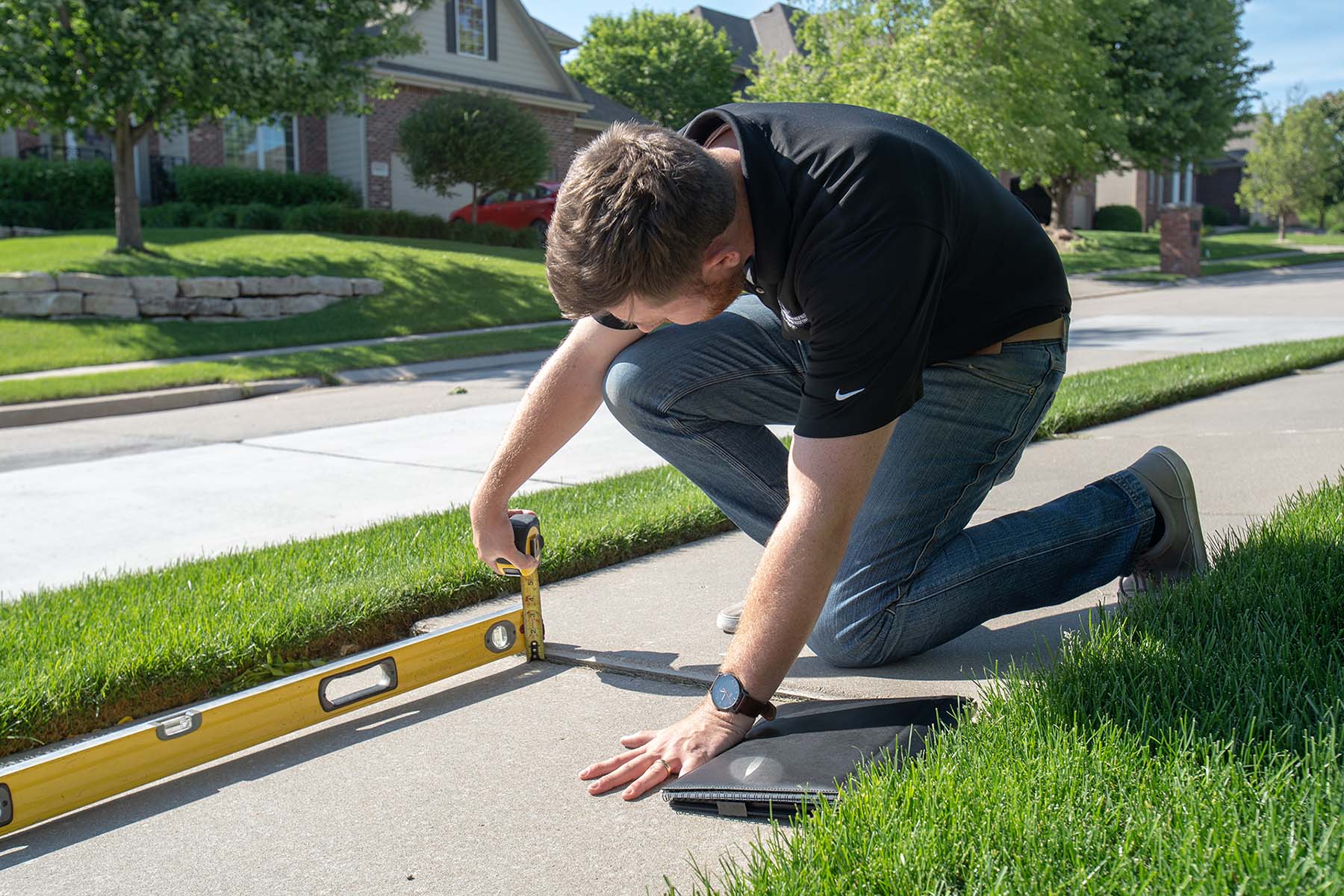
You caught your foot on the driveway edge this morning. The patio furniture has been wobbling for a week and you finally noticed the slab under it isn't level anymore. There's a seam on the front walk where one panel has risen above the other, and you've been stepping over it without thinking about it. These aren't new problems, but spring has a way of making them harder to ignore. The ground has been shifting under that concrete all winter, and what you're seeing now is where it ended up.
Concrete is durable. What gives out is the ground supporting it. Soil beneath a slab can compact over time, erode from water moving underneath, or wash out entirely in spots, leaving sections of the slab unsupported. When support becomes uneven, the slab follows. Parts of it drop while other sections stay put, and that's when you start seeing the gaps, the tilts, and the edges that catch your foot.
Poor drainage speeds this up. Water that pools near a slab or runs underneath it carries soil away gradually. Frost heave adds to it: frozen ground expands and pushes concrete up, then retreats when it thaws, and the slab doesn't always settle back to where it started. Over several winters, that repeated movement adds up.
Some of these you've probably already noticed and chalked up to normal wear. A few might be new since last fall, after the ground finished its last round of freezing and thawing. Taken individually, they're easy to write off. Together, they point to soil that has shifted and isn't coming back on its own:
If more than one of these sounds familiar, the concrete has likely been shifting for a while.
Replacing a sunken slab is disruptive and expensive. The old concrete gets broken up and hauled away, new material gets poured, and then you wait for it to cure. The surrounding area takes a beating in the process, and you're left with a section that doesn't match the rest of your concrete in color or texture.
Polyurethane foam lifting is a different approach. Small holes are drilled into the slab, and expanding foam is injected underneath. The foam fills voids, compacts loose soil, and lifts the slab back toward its original position. The holes are patched, and the work is done in hours rather than days. There's no curing time and no torn-up yard.
It works on driveways, sidewalks, patios, garage floors, and interior slabs. The material doesn't wash out or compress over time the way fill soil can, which is part of why the repair holds.
Anchored Walls has worked on concrete settling problems across the region since the late 1970s. The crews that do this work have seen what the Iowa and Missouri freeze-thaw cycle does to residential concrete, and they know how to assess whether a slab is a candidate for lifting or whether something else is going on beneath it. Every job comes with a free estimate. If your concrete has shifted over the winter, it won't level itself out.Schedule a free estimate and find out what it would take to fix it.
Iowa winters don't go easy on the space beneath your home. Months of hard freezes drive ground moisture upward, and vented crawl spaces spend the cold season cycling in outside air that condenses on floor joists and wood framing. By the time the ground thaws in April, that moisture has had plenty of time to do real damage. Spring is when crawl space repair needs become visible, and when addressing them costs the least.
Freeze-thaw cycles in Iowa and northern Missouri go deeper than most of the country. The ground freezes several feet down, and when it thaws, it releases significant moisture upward through the soil. A crawl space with a dirt floor and no vapor barrier, or one with a barrier that has shifted or torn, sits directly in the path of that moisture.
Vented crawl spaces make it worse. The original reasoning behind crawl space vents was that circulating air would keep moisture from building up. What actually happens is that cold, humid air flows in and condenses on the warmer surfaces inside the space, which are your floor joists. That condensation doesn't evaporate quickly in an Iowa winter. It sits against the wood for months.
A musty smell on the ground floor that was not there last fall is often one of the first signs of crawl space trouble. In many homes, that odor is caused by mold growing below the floor. Mold spores can move upward through gaps in the subfloor and into the rooms above. If a space smells damp even after cleaning, the air may be coming from the crawl space.
Standing water is another common warning sign. Homeowners may notice:
These conditions usually mean the crawl space is holding too much moisture and is no longer managing water the way it should.
Floor joists and support beams are dimensional lumber, standard-cut boards like the 2x8s and 2x10s that make up most residential framing. The sill plates resting directly on your foundation are required by code to be pressure-treated. The joists above them usually are not. That wood absorbs moisture from the surrounding air, and a crawl space that spent winter in high-humidity conditions gives that framing sustained exposure. Repeated swelling and shrinking loosens connections and degrades the structural integrity of the frame over time.
Wood rot develops separately. The fungi that break down wood fiber are present in nearly every soil environment, kept dormant by the absence of sustained moisture. Once humidity stays elevated long enough, they activate. A joist showing early rot doesn't look like much. Give it another season without attention and the picture changes considerably.
Pests follow moisture too. Termites need humidity to survive and are drawn to wood that has already been softened by it. Rodents look for dark, damp spaces with nesting material available, and deteriorating crawl space insulation fits that description well.
Most crawl space problems trace back to moisture getting in and having nowhere to go. Anchored Walls has been solving that problem for Iowa and northern Missouri homeowners since 1978.
A crawl space encapsulation starts with a heavy-duty vapor barrier installed across the floor and up the walls, cutting off ground moisture before it reaches the wood framing above. For humidity that remains after the ground is sealed, a dedicated crawl space dehumidifier maintains consistent moisture levels throughout the year without requiring manual attention.
When water intrusion is active, a perimeter drainage system channels water to a sump pump before it spreads across the floor. For crawl spaces where joists or support beams have already been weakened, steel support jacks and beam reinforcement restore structural stability and stop further movement.
Mold spreads. Wood weakened by moisture keeps degrading. A crawl space problem addressed in April is a smaller repair than the same problem left until fall. Anchored Walls inspects crawl spaces at no charge across Iowa and northern Missouri and provides a written estimate before any work begins.
Iowa winters are not gentle. By the time March arrives, your driveway, sidewalk, and patio have been through months of freezing temperatures, snowmelt, and repeated freeze-thaw cycles that most homeowners never think twice about. But the ground underneath your concrete has been working against it all season long, and the evidence tends to show up right when the weather finally breaks.
Temperature swings define Iowa's winters. A warm afternoon in January can send meltwater seeping into the soil beneath your concrete, and when temperatures drop again overnight, that moisture freezes and expands. This process, known as frost heave, pushes up against your concrete slabs from below with significant force.
Over time, and after dozens of these cycles in a single season, the soil underneath your driveway or sidewalk shifts unevenly. Some areas are compact, others expand, and the concrete above them follows. What starts as a barely noticeable tilt becomes a visible dip or a raised edge that catches your foot every time you walk past it.
Iowa's clay-heavy soils make this especially pronounced. Clay absorbs and holds moisture more than sandy or loamy soils, which means there is more water in the ground to freeze and expand with every cold snap.
When the ground finally thaws and settles, the concrete does not always settle with it. Slabs that were pushed up or undermined during the winter are left sitting unevenly, with voids beneath them where soil has shifted or washed away. That is when the visible damage becomes hard to ignore.
Sunken or raised sections along your driveway are the most obvious sign. You may also notice cracks running across slabs, gaps forming between your concrete and the garage floor, or sections of your sidewalk that rock underfoot. Pooling water is another red flag. When slabs tilt toward your home instead of away from it, water follows, and that drainage problem can create issues for your foundation over time.
The frustrating part is that most of this damage was not caused by anything you did wrong. It is simply what Iowa winters do to concrete that sits over soil that freezes, shifts, and thaws season after season.
When homeowners see sunken or cracked concrete, the instinct is often to assume it needs to be torn out and replaced. But in most cases, that is not true. If the slab itself is structurally sound, the real problem is the soil underneath it, and that is exactly what concrete leveling addresses.
Anchored Walls uses polyurethane foam lifting to raise sunken slabs back to their original position. A small hole is drilled into the affected slab, and a high-density foam is injected beneath it. The foam expands to fill voids, stabilize the soil, and lift the concrete back into place. The process takes a fraction of the time and cost of replacement, and the results are immediate.
It is also a smarter long-term investment. New concrete is just as vulnerable to Iowa's freeze-thaw cycles as the slab you already have. Leveling addresses the underlying soil problem rather than simply starting the clock over on the same issue.
Spring is the best time to address winter concrete damage, but the homeowners who get ahead of it are the ones who schedule early. Once the ground fully thaws and temperatures stabilize, Anchored Walls can assess the damage and get your concrete back where it belongs before the problem gets worse or creates a safety hazard on your property.
Sunken concrete does not stay in one place. Every rainfall that pools in a low spot, every vehicle that crosses an uneven driveway edge, and every summer heat cycle puts additional stress on slabs that are already compromised. What is a manageable fix in the spring can become a more involved repair by fall.
If you noticed new cracks, sinking, or uneven sections this winter, now is a good time to get it on your radar. Anchored Walls offers free estimates with no pressure, and our team can tell you quickly whether leveling is the right approach for your situation.
Concrete damage from an Iowa winter rarely fixes itself. The voids left behind by shifting soil stay empty, slabs continue to settle, and the cracks that started small get wider with every freeze-thaw cycle that follows.
The good news is that most winter concrete damage is very fixable, and the sooner it is addressed, the simpler and less expensive the repair tends to be. Anchored Walls has been helping Iowa and northern Missouri homeowners restore their concrete for over 40 years. We know what winter does to slabs in this part of the country, and we know how to fix it.
Schedule your free concrete leveling estimate today and go into spring with one less thing to worry about.
It usually starts with a smell.
A musty odor is creeping up from the basement. Maybe some discolored spots on the wall, or a fuzzy patch near the floor. At first, it’s easy to brush off, just an old house smell, a bit of dust, maybe something you’ll get around to cleaning.
But mold and mildew in the basement are rarely just surface-level. They’re signs of a deeper water problem beneath your home. And the longer you ignore them, the more damage they can do to your walls, your air quality, and your peace of mind.
Whether you’ve spotted growth or simply noticed that stale, damp feeling in the air, Anchored Walls is here to help you stop the moisture at its source.
Mold and mildew need just two things to grow: moisture and poor airflow. Unfortunately, basements provide both.
Water enters through cracks in the foundation, collects near footings, or seeps in through porous concrete walls. Even if there’s no visible flooding, the constant pressure of groundwater around your foundation can force moisture through the walls, a process known as hydrostatic pressure. That moisture lingers in the air, creating a damp environment where mold spores thrive.
Cool, still air and limited ventilation make basements the perfect place for those spores to settle and spread. Over time, what starts as an invisible problem becomes visible on walls, floors, and anything stored nearby.
If you’re seeing mold, you’re already dealing with a basement that’s too wet.
Mold doesn’t always announce itself with a bold patch on the wall. In many homes, the symptoms start small, easy to miss, but impossible to ignore once you know what to look for.
Musty smell that never goes away
Even if you can’t see it, that damp, stale odor rising from the basement is often the first sign that mold is spreading behind walls or under floors.
Dark streaks or patches on walls
Black, green, or brown spots, especially near the base of foundation walls, may point to mold growth caused by hidden moisture intrusion.
White fuzz or discolored spots near floor joints
Efflorescence or surface mold often appears on joists, insulation, or stored items where humidity builds up over time.
Peeling paint or chalky residue
Paint that bubbles, flakes, or shows a dusty film could be reacting to constant moisture behind the wall, making it a perfect host for mold.
Coughing or allergies that worsen in the basement
Mold spores can trigger breathing issues, especially in damp, closed environments. If symptoms improve upstairs, your basement air may be to blame.
Basement mold isn’t just a stain; it’s a symptom. And covering it up won’t stop what’s causing it.
Many homeowners try to paint over moldy patches or seal their walls with waterproof coatings. But if the foundation is still allowing moisture in, the mold will come back, sometimes hidden, sometimes worse. Mold doesn’t need standing water to grow. It only needs a damp surface and a little time.
Store-bought cleaners might remove what’s visible, but they don’t fix the cracks, the water pressure, or the vapor coming through the walls.
That’s why true mold control starts with stopping the moisture. Until you fix what’s happening behind the surface, you’re only treating the symptoms, not the source.
At Anchored Walls, we understand that mold is never just a surface issue; it’s a sign that your basement is holding more moisture than it should.
With over 40 years of experience serving Iowa and Missouri homeowners, our team specializes in solving the cause of basement mold. Whether it’s a foundation crack letting water seep in, poor drainage around the home, or water vapor pushing through the walls, we design a solution that stops the moisture at its source.
Our services may include:
Every fix is built for long-term performance, no shortcuts, no surface-only treatments. We don’t just want your basement to look better. We want it to stay dry, clean, and safe for years to come.
Mold and mildew are signs that your basement is holding too much moisture, and that the problem may be growing behind the walls. Anchored Walls can help you find out why it’s happening and fix it for good.
Schedule a free evaluation today. Our team will inspect your basement, explain what’s causing the issue, and recommend a long-term solution you can trust.
If you’ve patched the same crack in your foundation wall more than once, you’re not alone. Many homeowners try to seal up small cracks only to see them reappear months or even weeks later. It’s frustrating, and it can feel like the house is working against you.
The truth is, recurring cracks are often a sign of a deeper problem that patching alone can’t solve. Let’s explore why these cracks keep recurring and how to determine when it’s time to consider a more comprehensive solution.
Foundation walls are constantly under pressure. Whether it’s from expanding soil, poor drainage, or freeze-thaw cycles, the forces acting on your basement walls don’t go away after a surface crack is filled.
If the underlying pressure isn’t addressed, the wall will continue to move, and that crack will reopen or form somewhere else nearby. In many cases, patching only covers the symptom, not the cause.
If you’re seeing any of the following, your foundation likely needs structural support, not just cosmetic repairs:
These are all signs that the foundation is moving, and no amount of patching will stop that.
When a foundation wall is bowing, settling, or shifting, it needs more than just surface-level repair. Structural stabilization is often the only way to stop the movement and prevent cracks from coming back. This is where solutions like wall anchors or helical tiebacks become essential. These systems are designed to address the source of the pressure by reinforcing the wall and restoring stability. Wall anchors can gradually pull the wall back toward its original position, while helical tiebacks provide lateral support to stop further inward movement. Once the foundation is stabilized, any existing cracks can be sealed properly, knowing they are no longer under stress from shifting or bowing.
It’s easy to put off foundation repairs when cracks seem small or harmless. But in many cases, the real damage is happening behind the scenes. A crack that reopens may be a sign of ongoing wall movement, and that movement can lead to much more serious problems over time.
When pressure from outside the foundation goes unaddressed, the damage can escalate quickly. Here’s what homeowners risk by waiting too long:
What starts as a hairline crack can grow into a costly repair. Acting early is the best way to protect your home and your budget.
If you’ve patched the same crack more than once, or if you’re noticing new cracks appearing, it’s time to get a professional evaluation. At Anchored Walls, we specialize in diagnosing and solving foundation wall problems at the source.
Our solutions are designed to last, not just to hide the symptoms.
As summer heat dries out Iowa’s clay-heavy soil, the ground around your foundation begins to contract. This shrinkage can create gaps between the soil and your foundation walls, putting stress on the structure and leading to cracking. Even small fissures can allow moisture to seep in, especially as fall storms arrive.
When left unchecked, these cracks may widen or deepen, eventually affecting the stability of your home. That’s why late summer is the best time to identify and repair the problem before rain and freezing temperatures exacerbate the issue.
Once autumn arrives, Iowa’s weather becomes wetter, and that spells trouble for untreated foundation cracks. Even small gaps in your foundation can allow rainwater to seep in, especially during heavy downpours. That water intrusion can lead to:
Additionally, as the soil rehydrates after a dry summer, it expands and begins pushing against your foundation walls. If those walls are already weakened by cracks, this pressure can worsen the damage, leading to bowed or buckling walls that require more extensive repair.
Winter brings freezing temperatures that can make existing foundation cracks far worse. If water has entered those cracks during the fall, it can freeze and expand once temperatures drop, widening the gaps and stressing your foundation further.
This can result in:
On top of that, frozen ground makes many repairs more difficult to complete, or even impossible, until spring. Acting now avoids winter delays and keeps your foundation protected through the harshest months of the year.
Summer offers the most favorable conditions to inspect and repair your foundation. The warm, dry weather creates a stable environment for crews to work efficiently and safely, with fewer delays due to rain or frozen ground. Cracks are easier to spot, and soil movement is more predictable, making it the ideal time to address structural issues before they grow.
Foundation repair in summer also gives you time to plan and budget without the pressure of an active leak or emergency. With more daylight hours and flexible scheduling, homeowners can complete the project on their terms, rather than reacting to sudden damage later in the year.
If you're considering repairs, taking action in summer gives you peace of mind heading into fall and winter. You’ll know your home is protected, and you’ll avoid the seasonal rush when contractors’ schedules fill up fast.
If you’ve noticed cracks in your foundation or walls, don’t wait for the weather to turn. Anchored Walls has been serving Iowa homeowners for over 40 years with trusted solutions that last.
Call today to schedule your free inspection and get expert advice from a local foundation repair company you can count on.


By submitting this form and signing up for texts, you consent to receive text messages from Anchored Walls at the number provided, including messages sent by auto dialer. These may include messages related to estimates, project updates, appointment scheduling, and promotional offers. Consent is not a condition of purchase. Msg & data rates may apply. Msg frequency varies. Unsubscribe at any time by replying STOP or clicking the unsubscribe link (where available) and no further messages will be sent. Reply HELP for help. Information will not be shared with third parties for marketing or promotional purposes. Privacy Policy

